

Bridgwater is famous for a few things: its Carnival that could wake the dead, its Battle of Sedgemoor that ended with some very cross monarchists, and its bricks and tiles which fuelled the Industrial Revolution. But perhaps its greatest export wasn’t fireworks or clay at all.
It was a man. A man with a beard so powerful even Cromwell respected it.
Admiral Robert Blake.
Born in Bridgwater in 1598, Blake grew from a Somerset lad into one of the most significant, and strangely overlooked, figures in naval history. Nelson gets statues in London. Blake gets seagulls pooing on his a statue in Bridgwater. But don’t let that fool you: this man basically invented modern naval warfare.
And you can walk in his footsteps, right here in the town where it all started.
From Bridgwater boy to global commander
Blake was baptised at St Mary’s Church in 1598. We like to imagine him as a bored child staring at the pulpit, daydreaming about boats. After school in Bridgwater, he went on to Oxford, briefly dabbled in politics, then plunged headfirst into the chaos of the English Civil War.
When the Parliamentarians needed a navy, Blake, a man with zero naval training, somehow became its admiral. And it worked. He introduced tactics like blockades, line-of-battle formations and coordinated cannon fire. He turned floating collections of sailors into organised fleets.
In other words, he wrote the textbook for the Royal Navy… a century before Nelson.
Battles, blockades and a state funeral (sort of)
Blake’s campaigns stretched from Portugal to the Mediterranean. He fought Barbary pirates, beat the Dutch in the First Anglo-Dutch War, and pulled off daring raids as far as Tenerife. His reforms laid the groundwork for Britain’s naval dominance for the next 200 years.
When he died in 1657, Parliament gave him a hero’s burial in Westminster Abbey. But history has a cruel sense of humour: after the monarchy was restored, Charles II ordered Blake’s body dug up and thrown into a common grave. Restoration politics which is a bit like TripAdvisor reviews, but nastier.
Where to see Robert Blake in Bridgwater
If you want to meet Blake properly, Bridgwater still tells his story:
- Blake Museum (his birthplace): A small but fascinating museum dedicated to the man himself. See maps, models and artifacts that chart his life and legacy. You’ll also find local history collections that tell the wider story of Bridgwater.
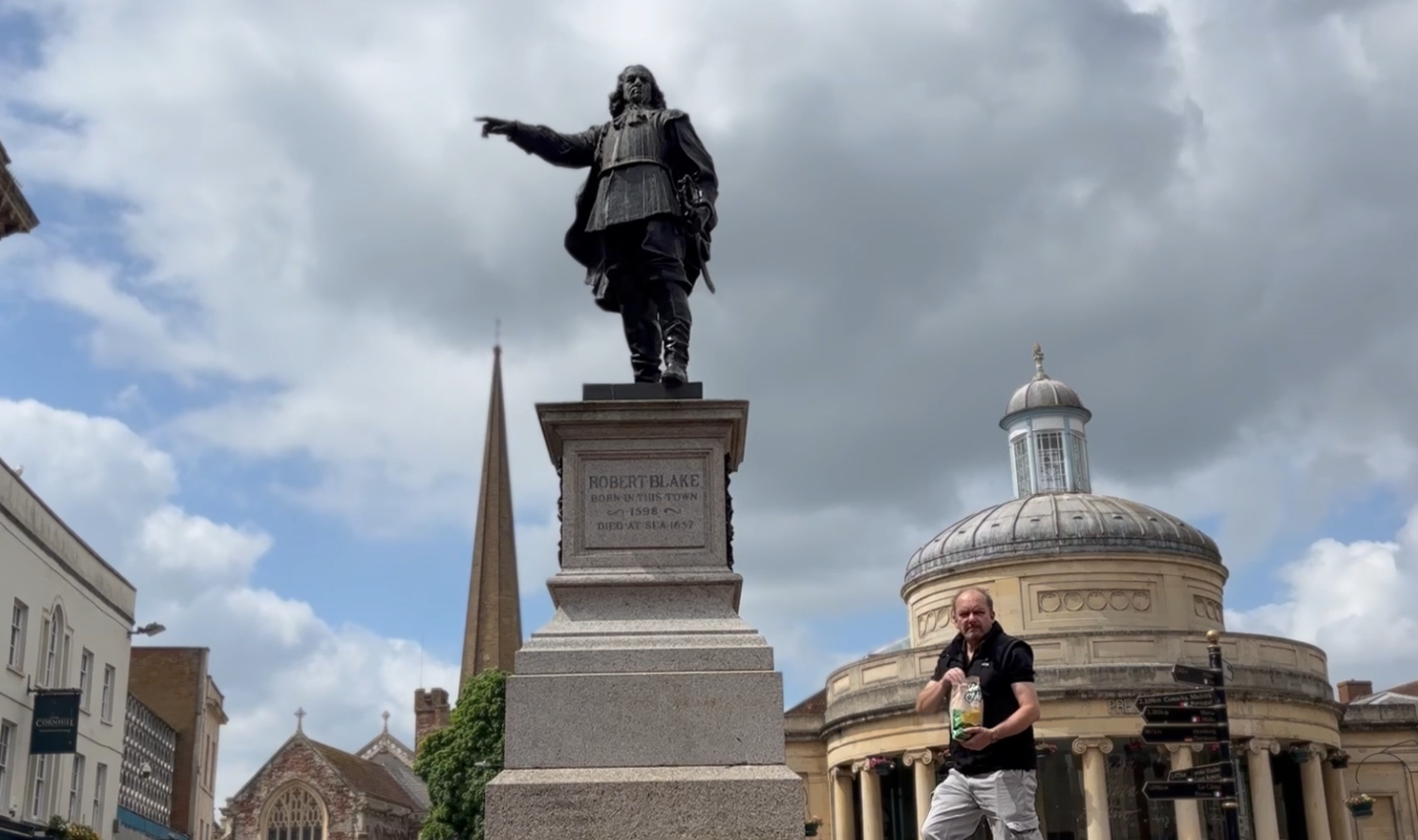
- Blake Statue (town centre): Erected in 1900, Blake’s statue stands proudly in the Cornhill area. He points dramatically into the distance – possibly the Blake Museum. Possibly Greggs. Either way, it’s a good selfie spot.
- St Mary’s Church: Where Blake was baptised. Stand in the pews and imagine him fidgeting through sermons, thinking about sails instead of psalms.
A forgotten hero
So why isn’t Blake a household name? Timing. He fought for Cromwell, and after the monarchy returned, his achievements got quietly shelved. But in Bridgwater, he’s remembered: through the museum, the statue, plaques, schools and even pubs that bear his name.
Walk around the town and you’ll see how Bridgwater keeps the admiral who helped shape the seas close to their heart.
Visiting Bridgwater: Blake and beyond
A day tracing Blake’s legacy is the perfect excuse to explore the rest of Bridgwater. Here’s how to plan it:
- Start at Blake Museum: Dive into the exhibits and meet the volunteers (locals love a good chat).
- Walk to St Mary’s Church: Admire its towering Gothic spire and step inside to see where Blake’s story began.
- Lunch in town: Try one of the cafés or pubs nearby. It’s Think Local First territory, so your sandwich probably comes with history.
- End at the Blake Statue: Snap a photo and compare poses. Point into the distance dramatically. Bonus points if you pick something mundane like “the bus stop.”
Practical visitor info
- Location: Blake Museum, 5 Blake Street, Bridgwater town centre.
- Opening times: Usually Tuesday–Saturday, but check ahead.
- Accessibility: Museum is in an old house; and you need to climb stairs to see the upper floor. But the town centre walk is easy and compact.
- Travel: Bridgwater is just off the M5, with pay-and-display parking in town. The museum and church are walkable from the centre.
Other things to do in Bridgwater
If Blake has whetted your appetite, Bridgwater has plenty more:
- Battle of Sedgemoor site & Westonzoyland Church — about 2 miles out of town. England’s last pitched battle, and worth the hike
- Brick & Tile Museum — see how Bridgwater became an industrial powerhouse through clay and fire.
- Bridgwater Carnival — if you visit in November, stay for the world’s biggest illuminated parade. Think Mardi Gras with tractors.
- Slave Trade history walk — learn about Bridgwater’s radical petition against slavery in 1785.
- St Mary’s Church – A local church with a big spire and some amazing architecture inside
Find out more with our guide: Things To Do In Bridgwater
Final thoughts: a giant who stood on deck (and in Bridgwater)
Robert Blake may not have the PR machine of Nelson, but in Bridgwater he’s ours, beard, blockades and all. From the museum where he was born, to the church where he was baptised, to the statue pigeons still claim today, he’s written into the stones and streets of the town.
So next time you think of naval heroes, don’t just picture Nelson’s column. Picture Bridgwater’s statue, and the man from Somerset who changed the way the world sailed.